A Beginner's Guide to Retrieval-Augmented Generation (RAG)
Have you ever chatted with an AI that just... made something up? Like, it confidentially told you that the moon is made of blue cheese, or that the current President of the United States is someone who left office years ago?
These "hallucinations," as they're called, are one of the biggest challenges with Large Language Models (LLMs)—the super-powerful AIs behind tools like ChatGPT. But there's a new technique in town that's helping fix this problem: Retrieval-Augmented Generation (RAG).
Don't let the technical-sounding name intimidate you. RAG is actually a very simple concept to understand. In this post, we'll break it down step by step and give you a few simple examples.
What is RAG?
In plain English, RAG is a way to give an LLM a reference library to use when it answers your questions.
Instead of relying solely on the vast but static knowledge it was trained on, an LLM with RAG can:
Retrieve relevant, up-to-date information from a source you provide (like your own documents, a specific website, or a database).
Augment its understanding of your question with this new information.
Generate an answer that is grounded in fact and relevant to your specific needs.
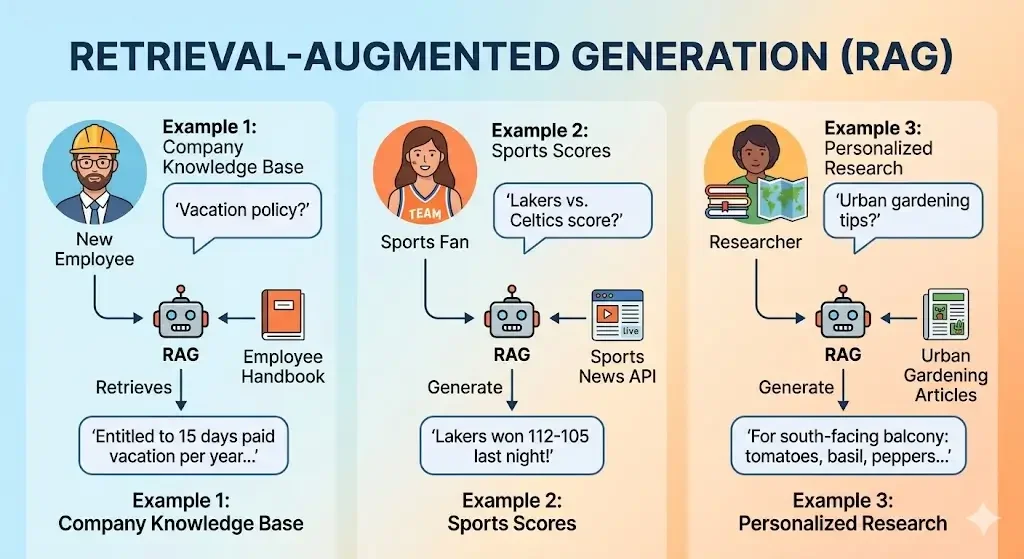
Retrieval Augmented Generation Infographic
Why is RAG Such a Big Deal?
Think of a standard LLM as a brilliant but incredibly forgetful student who has read almost every book ever written, but has no access to the internet or any new information since they graduated. If you ask them a question about current events or a specific company policy, they'll often give you a confident but incorrect answer.
An LLM with RAG is like that same brilliant student, but this time they have an open book and access to a trusted, up-to-date database. Now, when you ask them a question, they can:
Fact-check themselves.
Access the latest information.
Answer questions about private or specific data.
Significantly reduce those pesky hallucinations.
3 Simple Examples of RAG in Action
To make things even clearer, here are three everyday examples of how RAG can be used:
Example 1: Your Company's Internal Knowledge Base
Imagine you're a new employee at a large company, and you have a question about the vacation policy. Instead of searching through countless PDFs on the internal portal, you could ask a RAG-powered chatbot. The chatbot would:
Retrieve the relevant sections from the official employee handbook.
Augment its understanding of your question with the specific policy details.
Generate a direct, accurate answer, like: "According to the employee handbook (Section 4.2), you are entitled to 15 days of paid vacation per year, which accrue at a rate of 1.25 days per month."
Example 2: Up-to-the-Minute News and Sports
Let's say you want to know the score of last night's game. A standard LLM might not know, especially if it was trained months ago. But a RAG-powered assistant could:
Retrieve the latest sports scores from a trusted news API.
Augment its knowledge with the game's final score.
Generate an answer like: "The Lakers won last night, 112-105."
Example 3: Personalized Research or Learning
You're researching a new hobby, like urban gardening, and you've found several helpful articles. Instead of re-reading them multiple times, you could feed them into a RAG system. Then, you could ask specific questions, and the system would:
Retrieve relevant information from the specific articles you provided.
Augment its general knowledge of gardening with the specific tips in your articles.
Generate personalized answers, like: "For a south-facing balcony in an apartment (like the one mentioned in Article 2), the best plants to grow are tomatoes, basil, and peppers, as they love sunlight."
The Bottom Line
RAG is a game-changer for AI. By connecting powerful LLMs to relevant, trustworthy data, it makes them more accurate, reliable, and useful for a wider range of tasks. So the next time you interact with an AI that seems surprisingly well-informed, you might just be experiencing the power of RAG!